Brief introductions to selected research projects.
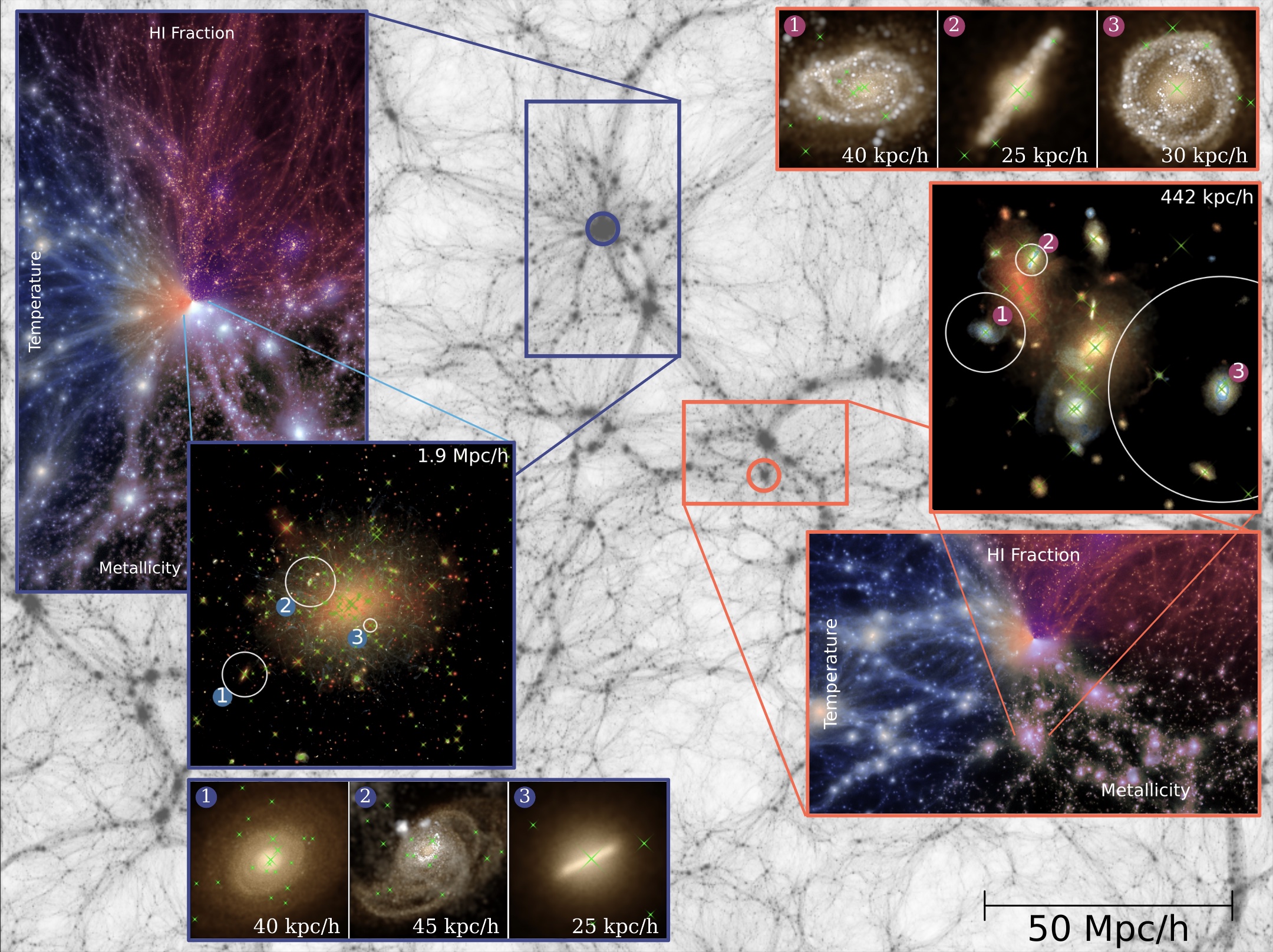
The ASTRID Simulation at $z=0$
Illustration of the ASTRID simulation at $z=0$. The image shows multiple physical fields in a slice of the simulation box.
ASTRID is one of the largest hydrodynamical cosmological simulations evolved to $z=0$. It hosts
$2\times5500^3$ particles in a box with 370 Mpc per side. It hosts a large population of
massive black holes (MBHs), spanning from $10^4$ to $10^{11}$ M$_\odot$, and includes a black hole
dynamical friction model that properly captures MBH orbital evolution.
The large dynamic range of Astrid on one hand allows detailed studies of galaxy and massive black hole evolution at high resolution,
and on the other hand allows systematic studies of rare massive systems with the large cosmic volume.
Astrid is now used to provide predictions or interpretations of current and future observations, such as the Pulsar Timing Array, Laser Interferometer Space Antenna (LISA),
and the Rubin Observatory's Legacy Survey of Space and Time (LSST), James Webb Space Telescope (JWST).
I am very grateful to have the opportunity to run the last chunk of ASTRID down to $z=0$.
The simulation datasets are now publicly available at https://astrid.psc.edu.
MAGICS: Massive Black Hole Assembly in Galaxies Informed by Cosmological Simulations
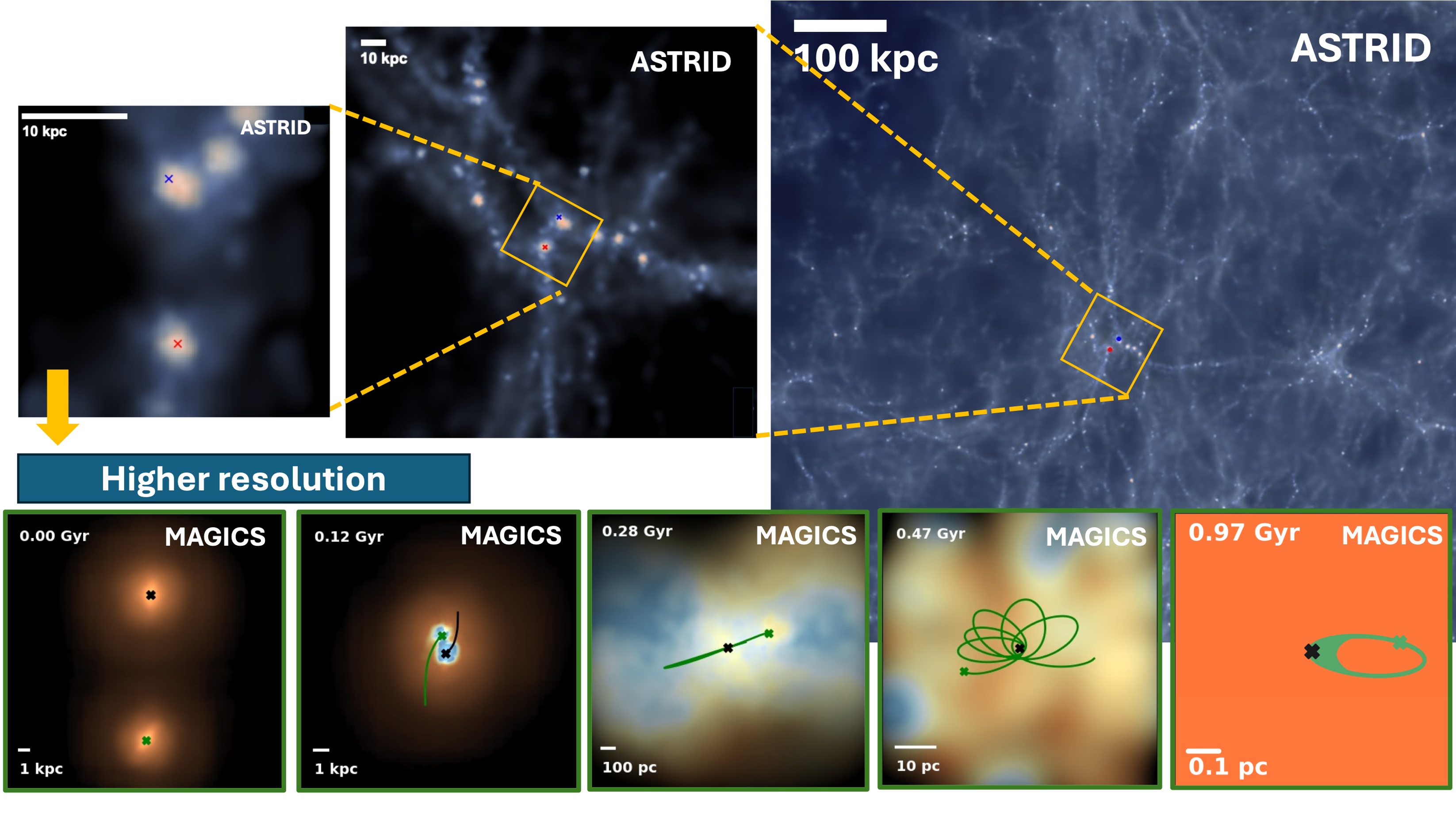
High-resolution follow-up simulations connecting cosmological environments to sub-parsec MBH dynamics.
MAGICS simulation suite bridges the gap between cosmological simulations and small-scale MBH dynamics.
We select 15 MBH seed merger events from ASTRID that are detectable by upcoming LISA, and reproduce them using high-resolution idealized simulations.
Besides the higher resolution, we also adopt improved gravity solvers, including the regularized integrator KETJU and the $N$-body code TAICHI.
This allows us to trace the MBH dynamics down to sub-parsec scales in realistic galaxy environments of LISA sources.
Based on MAGICS, we found that the MBH dynamics is significantly affected by the surrounding stellar environment, and that
nuclear star clusters (NSCs) can significantly accelerate MBH seed mergers.
This highlights the importance of understanding the MBH dynamics in realistic galaxy environments, and the need for high-resolution simulations to study this.
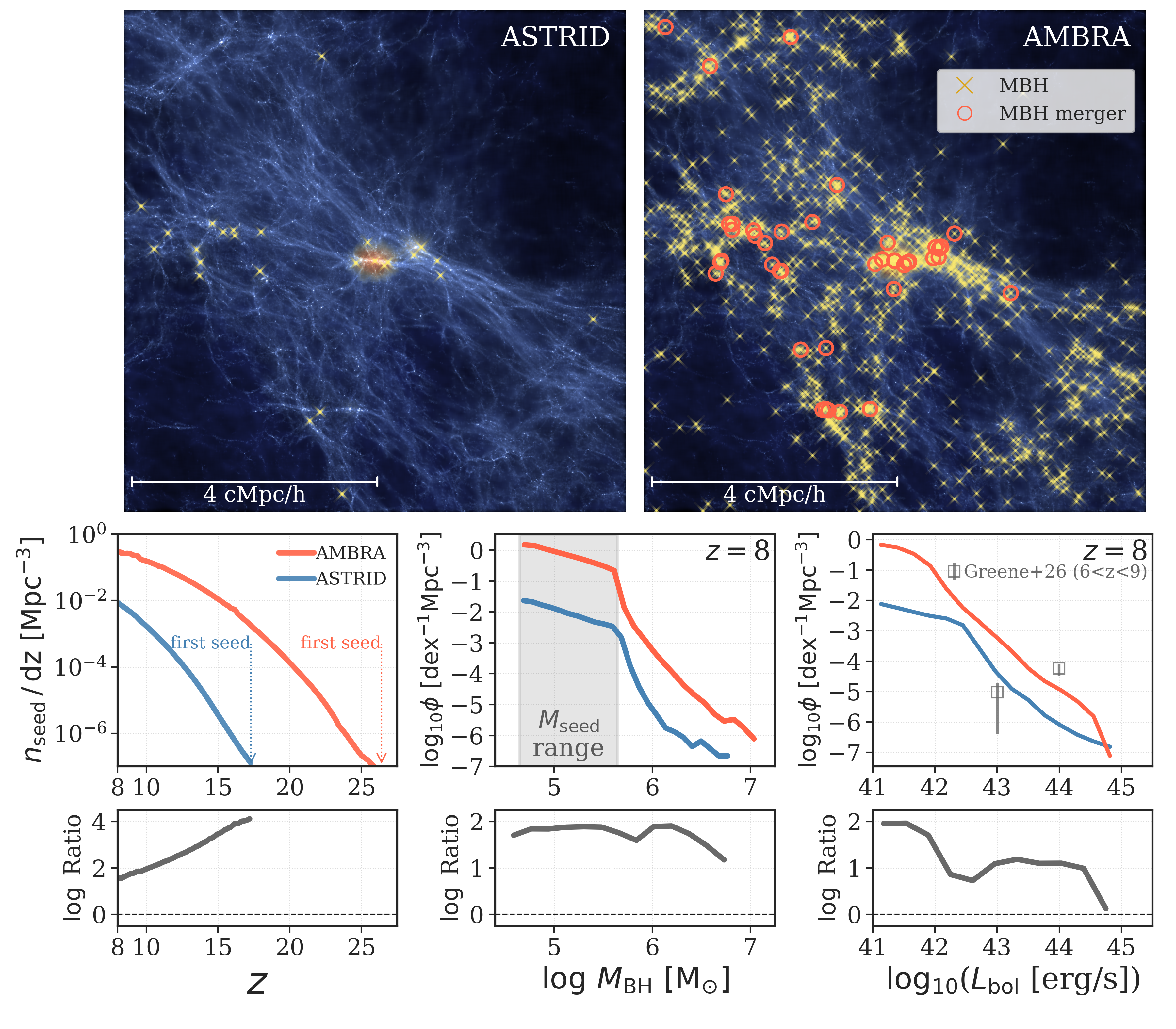
AMBRA combines ASTRID-scale statistics with physically motivated BH seeding from BRAHMA.
AMBRA combines the large cosmological volume of ASTRID with gas-based black hole seeding models from
BRAHMA. Motivated by JWST discoveries of massive BHs at $z\gtrsim 9$, AMBRA adopts a lenient heavy-seed
prescription that allows $4\times 10^{4-5}$ M$_\odot$ seeds to form in star-forming, metal-poor gas.
Compared with ASTRID, this model forms seeds earlier and more efficiently, and produces some of the massive black holes detected by JWST at high redshifts ($z\gtrsim 8$).
AMBRA simulation produces a population of Little Red Dots (LRDs); which allows us to have a systematic study of the evolution of these objects.
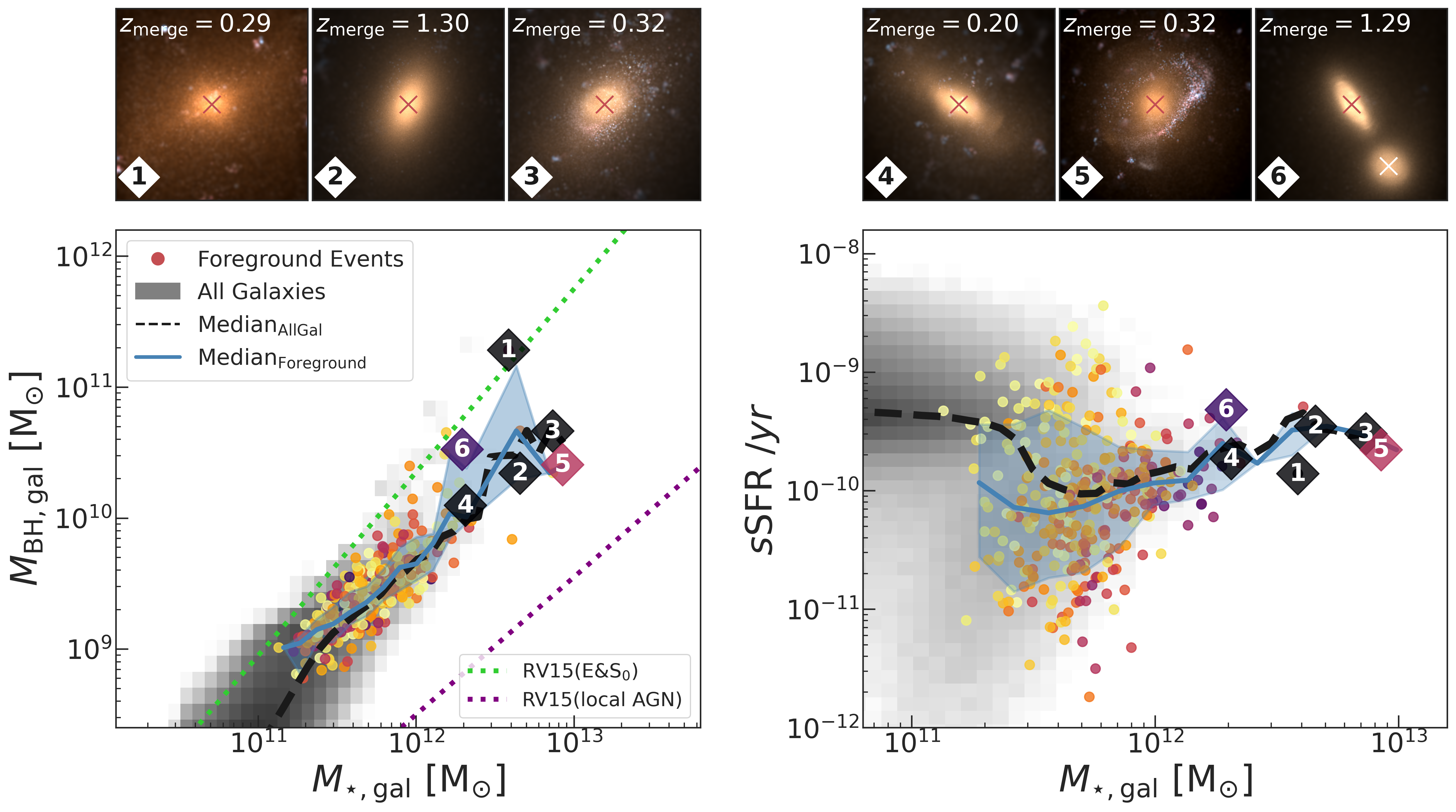
Predicted high-detectability PTA continuous-wave sources in the local universe.
We use the MBH population in ASTRID to predict continuous wave (CW) sources for PTA experiments.
The highest-detectability CW sources are hosted by central galaxies in massive galaxy clusters.
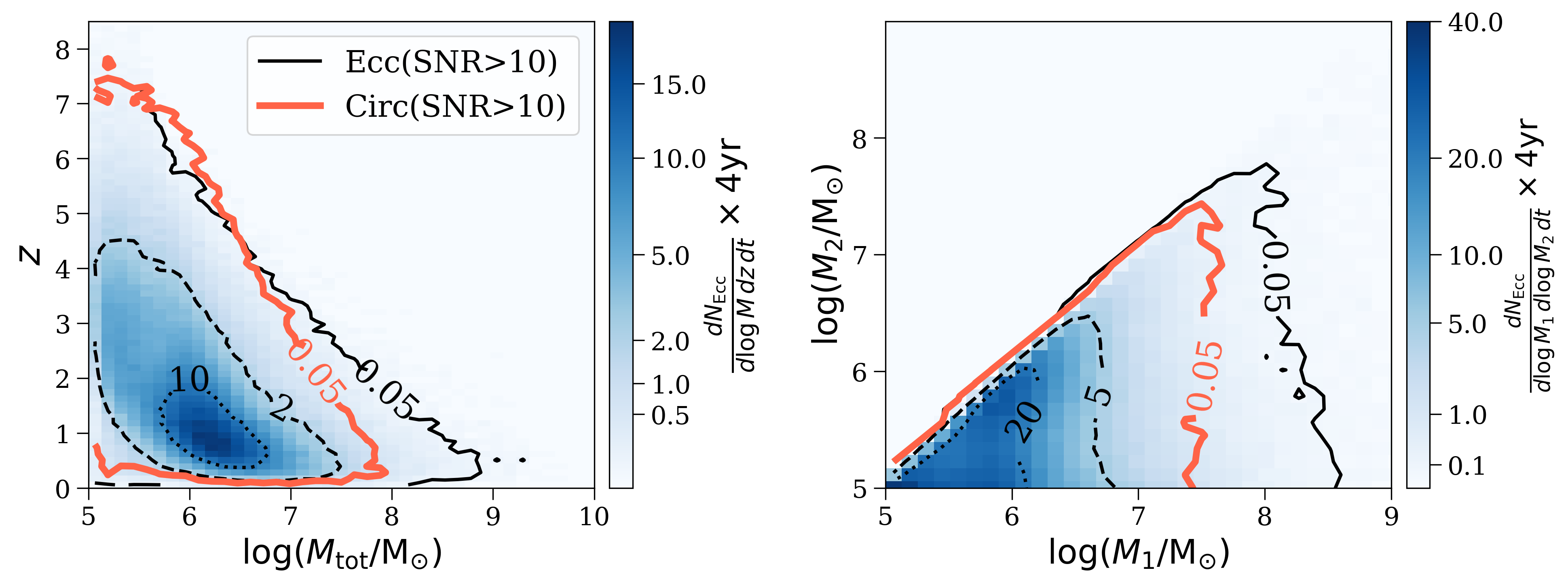
ASTRID-based predictions for LISA detections across black hole mass and redshift.
We predicted detection rates for LISA and found that accounting for orbital eccentricity
extends LISA sensitivity toward higher masses, up to approximately $10^9$ M$_\odot$.